Introduction
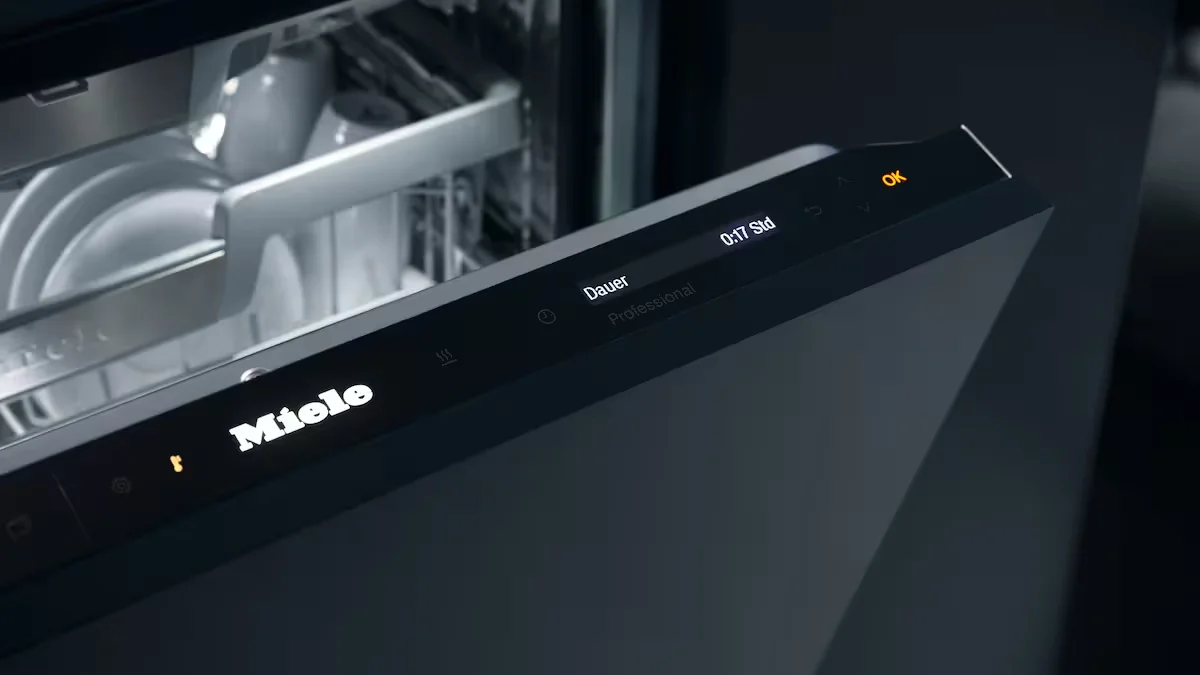
Miele dishwashers are premium appliances that have earned worldwide recognition for their German quality, reliability, and innovative technology. Miele was the first company in Europe to produce a dishwasher, and for decades since, the brand has been perfecting its appliances, delighting customers with technical innovations and impeccable quality.
In this guide, we’ll cover in detail what makes Miele dishwashers great, why they’re considered among the most reliable on the market, what problems may arise during operation, and how to properly care for these appliances so they’ll serve you for many years.
Why Miele Dishwashers Are So Good
1. Legendary Reliability and Durability
Miele dishwashers are designed for a service life of up to 20 years, which has been confirmed by numerous tests. This isn’t a marketing gimmick—the appliances are truly built to last for decades. The company conducts strict durability testing of each model, simulating thousands of operating cycles.
Manufacturing takes place at facilities in Germany, the Czech Republic, and Austria, where partial hand assembly and strict quality control are used. This significantly increases the cost of the appliances but guarantees exceptional reliability.
2. Quality of Materials and Components
Miele dishwashers use only premium materials:
- Stainless steel interior chamber — guarantees long service life, corrosion resistance, and high temperature tolerance
- High-quality heating elements — heat water quickly and last significantly longer than budget alternatives
- Reliable wiring and contacts — rarely fail even after extended use
- Durable plastic and metal in the housing and mechanisms
3. Innovative Technologies
Miele constantly implements advanced technologies in its dishwashers:
AutoDos (Automatic Dispensing System)
The built-in PowerDisk system automatically dispenses detergent in the right amount. One disk is designed for 20 wash cycles. This provides:
- Optimal detergent use
- Excellent wash results
- Long-term savings
3D MultiFlex
Proprietary silverware tray with width and height adjustment. Miele obtained a patent for this system back in the late 1980s, and it remains one of the most convenient on the market.
Knock2Open
A unique feature allowing you to open the dishwasher with a simple knock on the door—ideal for built-in models without handles.
AutoOpen
The door automatically opens slightly after the program finishes, providing excellent drying even for plastic dishes.
Turbothermic (Recirculation Drying)
Much more efficient than traditional condensation drying and takes less time. Dishes are dried with a powerful stream of hot air.
Waterproof System
Multi-level leak protection system:
- Special sensors monitor moisture levels
- When a leak is detected, protective valves shut off the water
- Prevents flooding and damage
4. Operating Economy
Despite the high cost, Miele dishwashers are economical in the long run:
- Low water consumption: only 10 liters per cycle (2-3 times less than hand washing)
- Energy efficiency class A+ and above: consumption of only 0.95 kWh per cycle
- Ability to connect to hot water supply (up to 60°C) — energy savings up to 35%
- EcoFeedback function — shows exact water and electricity consumption
5. Hygiene and Wash Quality
Miele dishwashers provide not just cleanliness, but hygienic safety:
- Destroys 99.9% of viruses — certified by the Institute of Comprehensive Hygiene and Virology
- “Hygiene” program with high temperature for baby dishes and bottles
- “Intensive 75°C” program for heavily soiled dishes
- Perfect GlassCare — gentle glass washing without streaks or cloudiness
6. Ease of Use
- Quiet operation: noise level from 38 to 46 dB—quieter than normal conversation
- Capacity: up to 14 place settings in standard models, up to 16 in XXL
- Flexible space organization: adjustable FlexLine baskets, FlexCare holders for glasses
- QuickPowerWash: fast wash program in 58 minutes even for heavily soiled dishes
- ComfortClose: door closes easily and smoothly, stays in any position
7. Model Variety
Miele offers a wide selection of dishwashers:
- Freestanding (45 and 60 cm)
- Built-in with exposed panel
- Fully integrated for seamless kitchen integration
- Compact models
- Professional for commercial use
Reliability: What Facts and Reviews Say
Independent Research Results
According to a Which magazine survey, Miele dishwashers became one of the most “strongly recommended” appliances by buyers, on par with Bosch and Siemens appliances. About 86% of consumers were satisfied with the German brand’s products.
Owner Reviews
Miele dishwasher owners note the following advantages:
Positive aspects:
- Impeccable wash quality even on the toughest stains
- Long service life without breakdowns (many models work 10-15 years without repair)
- Quiet operation—the machine is almost inaudible
- Convenient loading system
- Excellent drying
- Reliable leak protection
Rare complaints:
- High price (3-4 times more expensive than budget brands)
- Lack of child lock on some models
- Lack of half-load option on older models
Why Miele Is So Reliable
The secret of reliability lies in the manufacturing philosophy:
- Quality components: Miele doesn’t cut corners on parts
- Strict control: every machine undergoes testing
- Conservative design: time-tested solutions
- Hand assembly: at critical production stages
- Long testing: new models undergo years of testing before market release
Common Problems and Malfunctions
Despite high quality, Miele dishwashers aren’t immune to problems. It’s important to understand which malfunctions occur most often and how to avoid them.
Common Causes of Malfunctions
1. Water Quality Problems
Scale on heating elements — the most common problem. Due to hard water, scale forms on heating elements, leading to:
- Increased heating time
- Excessive electricity consumption
- Overheating and heating element burnout
Solution:
- Always use special dishwasher salt
- Properly set water hardness in machine settings
- Periodically run the machine with descaling cleaner
2. Clogs
Causes of clogs:
- Large food residues
- Grease and deposits
- Small items (bones, stickers, toothpicks)
Where clogs occur:
- Filters in the wash chamber
- Drain and inlet hoses
- Spray arms (nozzles)
- Drain pump
- Check valve
Solution:
- Regularly clean filters (every 1-2 weeks)
- Remove large food residues before loading
- Check spray arms monthly
3. Sensor Malfunctions
In Miele dishwashers, temperature sensors (NTC) most often fail. This is a specific feature of Miele machines—unlike other brands where heating elements or triacs more often burn out, in Miele it’s specifically the temperature sensors that are the weak point.
Signs:
- Water doesn’t heat
- Error codes F01, F02 on display
Solution: sensor replacement by a specialist
4. Leak Problems
Causes of leaks:
- Wear or damage to door seal
- Damage to inlet/drain hoses
- Worn pipe connections
- Clog or malfunction of drain valve
- Excess detergent
Prevention:
- Periodically inspect the seal
- Don’t use too much detergent
- Check hoses for damage
- Waterproof System protects, but don’t rely on it alone
5. Installation Errors
Many problems arise from improper installation:
- Machine installed too close to the wall
- Bent or pinched hoses
- Damaged seals
- Incorrect connection to drainage system
Solution: trust installation to professionals only
6. Power Supply Problems
Voltage fluctuations can damage:
- Control board
- Pumps
- Sensors
Solution:
- Use a voltage stabilizer
- With frequent voltage fluctuations, definitely install protection
Miele Error Codes
The self-diagnosis system displays error codes on the screen. Here are the main ones:
F01, F02 — temperature sensor problems (short circuit/open circuit) F11 — water not draining (check filters, hoses, pump) F12 — water not filling (check faucet, inlet valve, pressure) F18 — inlet valve constantly open F19 — water flow sensor malfunction F24 — water heating problems F36 — control module problems F42, F47 — electrical network problems (voltage fluctuations) F51 — program error F78 — circulation pump problems F607 — spray arm nozzles clogged (on models with AutoDos)
Important: error codes don’t indicate a specific part, only the direction for problem searching.
Proper Operation: How to Avoid Problems
First Start
Before first use, be sure to:
- Clean the machine of manufacturing contaminants:
- Wipe the interior surface with a damp cloth
- Remove stickers and foam elements
- Check that no packaging materials remain
- Fill the salt reservoir:
- Open the salt compartment lid (usually on the bottom)
- Pour in about 1 liter of water
- Pour in special salt until full
- Close the lid and wipe up excess water
- Add rinse aid:
- Open the rinse aid dispenser
- Fill to the mark
- Set dosage (usually medium setting)
- Set water hardness:
- Find out your local water hardness
- Set the corresponding level in machine settings
- This is critically important for preventing scale
- Run a test cycle:
- Run the machine without dishes with detergent
- Select intensive program
- This will remove residues of manufacturing oils
Dish Loading Rules
Proper loading is the key to quality washing and machine longevity.
General rules:
- Remove large food residues — but don’t rinse dishes completely
- Don’t overload the machine — dishes should have space for water flow
- Place dishes with concave side down — so water doesn’t collect
- Don’t block spray arms — they should rotate freely
- Dirtiest dishes go on bottom — where water jets are strongest
Lower basket:
- Large items: plates, pots, pans, baking sheets
- Place on edges — the larger, the closer to the edge
- Install plates vertically with slight tilt
- Turn pots and bowls upside down
- Pans and baking sheets — along the back or side wall
Upper basket:
- Cups, glasses, small plates
- Wine glasses — in special FlexCare holders
- Small bowls — at an angle so water drains
- Plastic containers — secure so they don’t flip over
Silverware tray (3D MultiFlex):
- Spoons and forks — handles down, separate them
- Knives — in special compartments, blades down
- Long utensils (ladles, spatulas) — in long compartments
- Don’t stack tightly — leave gaps
What not to wash in the dishwasher:
- Wooden dishes (swells and deforms)
- Cast iron dishes (rusts)
- Aluminum dishes (darkens)
- Copper, brass, bronze (oxidize)
- Crystal and fine china (may crack)
- Dishes with stickers
- Antique or painted dishes
- Thermoses and sealed containers
- Wooden handles
Program Selection
Modern Miele dishwashers have many programs:
ECO — economical program, takes longer but saves water and electricity. For normal dishes with medium soiling.
Auto/Sensor wash — automatically determines the degree of soiling and selects optimal parameters.
Intensive 75°C — for very dirty dishes, baking sheets with burnt-on grease, pots. High temperature and powerful jets.
QuickPowerWash — fast program (58 minutes) for heavily soiled dishes. Uses special UltraTabs tablets.
Delicate — for fragile dishes, fine glass, china. Lower temperature and pressure.
Hygiene — for baby dishes, cutting boards. Destroys 99.9% of viruses and bacteria.
Glassware — special program for gentle glass washing.
Pre-rinse — if dishes will be washed later, to prevent residues from drying.
Detergents
Types of detergents:
- 3-in-1, 5-in-1 tablets — convenient but more expensive
- Contain detergent, salt, and rinse aid
- Suitable for daily use
- Powder — more economical, can be dosed
- Dissolves well
- Suitable for hard water
- Gel — convenient to use
- Dissolves quickly
- Gentler on dishes
- Special Miele products (PowerDisk, UltraTabs)
- Specifically designed for Miele machines
- Provide optimal results
Important:
- Don’t use regular dish soap — creates too much foam
- Follow dosage — excess detergent won’t improve results but may cause leaks
- Always use salt — even if tablets contain salt, it’s not enough
- Rinse aid is mandatory — for perfect drying and shine
Temperature Settings
- 40-45°C — delicate program, glassware
- 50-55°C — eco program, normal wash
- 65-70°C — intensive wash
- 75°C — hygiene program
Tip: if dishes have different temperature requirements, choose gentle mode.
Regular Maintenance and Care
Proper care significantly extends service life and maintains wash quality.
Daily Care
After each cycle:
- Leave door slightly open for 10-15 minutes for airing
- Wipe door seal—moisture accumulates there
- Check that no large food residues remain
Weekly Care
Once a week:
- Filter cleaning:
- Remove lower basket
- Unscrew large filter counterclockwise
- Remove small mesh filter
- Rinse under running water with brush
- Check opening—remove large contaminants
- Reinstall filters
- Spray arm inspection:
- Remove upper and lower spray arms
- Check if holes are clogged
- Clear with toothpick if necessary
- Rinse under water
- Door and panel wiping:
- Wipe exterior panel with soft cloth
- Clean rubber seal
- Check for food residues along edges
Monthly Care
Once a month:
- Deep cleaning:
- Run empty machine with dishwasher cleaner
- Use high temperature program (75°C)
- This removes grease, scale, and odors
- Door seal cleaning:
- Thoroughly wipe seal folds
- Use soft brush for hard-to-reach places
- Remove mold if it appeared
- Drain pump inspection:
- Open service cover (usually lower right)
- Unscrew drain pump filter
- Remove debris and contaminants
- Check impeller—it should rotate freely
- Reinstall
- Nozzle inspection:
- Ensure all holes in spray arms are clean
- Soak in vinegar solution if necessary
Seasonal Maintenance (every 3-6 months)
- Descaling:
- Use special descaling agent
- Run intensive program without dishes
- Especially important with hard water
- Hose inspection:
- Inspect inlet and drain hoses
- Ensure no cracks or kinks
- Check clamp tightness
- Inlet hose filter cleaning:
- Turn off water
- Unscrew inlet hose
- Remove filter screen
- Rinse under water
- Reinstall
- Check valve inspection:
- Located in drain system
- Clear if necessary
- Prevents dirty water return
Professional Maintenance
Miele recommendations:
Conduct professional maintenance every 12-18 months. This includes:
- Complete system diagnostics
- Electronic component inspection
- Descaling of internal elements
- Seal replacement (if necessary)
- Sensor inspection
- Mechanism lubrication
- Safety inspection
Regular professional maintenance can help support long-term performance and may help with warranty-related documentation.
What to Do If Machine Isn’t Used for Long Periods
If planning extended break from use:
- Run complete cleaning cycle
- Thoroughly dry machine
- Leave door slightly open
- Turn off water
- Disconnect from power
- Drain remaining water from hoses (if necessary)
Troubleshooting Common Problems
Dishes Remain Dirty
Causes and solutions:
- Improper loading — dishes blocking spray arms
- Solution: reload properly
- Filters or spray arms clogged
- Solution: clean filters and nozzles
- Insufficient detergent
- Solution: increase dose
- Wrong program selected
- Solution: use more intensive program
- Low water pressure
- Solution: check water supply tap, system pressure
White Deposits on Dishes
Causes:
- Hard water
- Insufficient salt
- Excess rinse aid
Solution:
- Check water hardness setting
- Add salt
- Reduce rinse aid dose
Streaks on Dishes
Causes:
- Excess rinse aid
- Dirty filters
- Poor quality detergent
Solution:
- Reduce rinse aid dose
- Clean filters
- Try different detergent
Unpleasant Odor
Causes:
- Dirty filters
- Food residues in chamber
- Infrequent use
- Mold on seal
Solution:
- Thoroughly clean filters
- Run cleaning cycle with cleaner
- Wipe seal with antiseptic
- Leave door slightly open
Water Not Draining
Causes:
- Filter clog
- Drain hose clog
- Trap/drainage clog
- Drain pump malfunction
Solution:
- Clean filter
- Check drain hose for kinks
- Clear trap
- If pump malfunction—call technician
Water Not Filling
Causes:
- Water supply tap closed
- Low pressure
- Inlet hose filter clog
- Inlet valve malfunction
Solution:
- Open tap
- Check system pressure
- Clean inlet hose filter
- If valve malfunction—call technician
Noise During Operation
Normal sounds:
- Water noise
- Pump hum
- Program switching clicks
Abnormal sounds:
- Rattling, clanking — dishes poorly secured or touching spray arms
- Solution: reload dishes
- Grinding — something got into pump (fragments, bones)
- Solution: check and clean pump
- Whistling — water pressure problems
- Solution: adjust supply tap
When You Need a Technician
Some problems require professional intervention:
- Not heating water (heating element or temperature sensor malfunction)
- Won’t turn on (electronics problems)
- Errors F36, F47, F51 (control module malfunction)
- Constant leaks after checking seals and hoses
- Pump not working (circulation or drain)
- Burnt electronic components
Important: for Miele appliances, choose experienced, licensed, and insured technicians familiar with Miele systems. Using appropriate replacement parts and proper repair procedures is important for safety, performance, and warranty-related considerations.
Useful Tips for Maximum Efficiency
- Run full cycles — don’t wash 2-3 plates, better to accumulate dishes
- Use Eco program for daily washing — more economical with good results
- Let dishes cool before loading—hot dishes are more fragile
- Open door immediately after cycle — steam will escape, dishes will dry better
- Don’t open door during operation unnecessarily—disrupts program
- Load immediately after meals — so residues don’t dry
- Use delayed start — can wash dishes at night at reduced rates
- Run intensive program monthly — even if you usually wash on Eco
- Monitor salt and rinse aid indicators — don’t let them completely empty
- Store tablets in dry place — they absorb moisture and lose effectiveness
Choosing a Miele Model: What to Look For
Dimensions
- 60 cm (standard) — holds 12-14 place settings, suitable for family of 3-5
- 45 cm (narrow) — holds 9-10 place settings, for small kitchens or couples
- XXL (height 84.5 cm) — up to 16 place settings, maximum capacity
Installation Type
- Freestanding — can be moved, top cover serves as work surface
- Built-in — front panel visible, can be decorated or use CleanSteel
- Fully integrated — completely hidden behind kitchen facade
Key Features
Essential:
- Waterproof System (leak protection)
- AutoOpen (automatic opening for drying)
- 3D MultiFlex (utensil tray)
- Energy efficiency class A+ and above
Desirable:
- AutoDos with PowerDisk (automatic dispensing)
- QuickPowerWash (fast wash)
- Knock2Open (for fully integrated models)
- EcoFeedback (resource consumption monitoring)
Premium features:
- Wi-Fi connectivity (smartphone control)
- Additional specialized programs
- Enhanced sound insulation (down to 38 dB)
Budget
Miele dishwashers aren’t cheap, but they’re a decades-long investment:
- Entry level (G5000): from $1,200
- Mid-level (G7000): from $1,800 to $3,000
- Premium (G7000 with AutoDos, XXL): from $3,000 to $4,500
- Top models: from $4,500 to $10,000
Yes, this is 3-4 times more expensive than budget brands. But considering 20-year service life, reliability, and repair savings—the price is justified.
Conclusion
Miele dishwashers are the choice of those who value German quality, reliability, and are ready to invest in appliances for many years. Yes, the initial cost is high, but it pays for itself:
- Durability — up to 20 years of service
- Savings — low water and electricity consumption
- Reliability — minimal breakdowns with proper operation
- Wash quality — impeccable cleanliness and hygiene
To ensure your machine serves as long as possible:
- Install properly (trust professionals)
- Use quality products (salt, detergent, rinse aid)
- Regularly clean filters and spray arms
- Load properly dishes
- Conduct maintenance every 12-18 months
- Use stabilizer if electrical problems
- Monitor water hardness and scale
When problems arise:
- Check simple causes yourself (filters, hoses, loading)
- For serious malfunctions, contact an experienced, licensed, and insured appliance technician.
- Use original parts
A Miele dishwasher isn’t just another household appliance—it’s a reliable kitchen helper that, with proper care, can serve you for many years while saving time, effort, and stress.
Important: This guide is for general informational purposes. Always consult your specific model’s original operating manual from the manufacturer.